5 Reasons Your Castings Have Porosity (And How to Fix It)
Every jewellery manufacturer knows the sinking feeling: you’ve invested time, precious metal, and craftsmanship into a casting, only to discover tiny air bubbles riddling your piece. Porosity isn’t just an aesthetic problem—it’s a structural weakness that can lead to rejection from quality control, unhappy clients, and wasted resources.
If you’re battling porous gold castings, you’re not alone. Porosity remains one of the most common and costly defects in casting operations worldwide. But here’s the good news: once you understand what causes these microscopic air pockets, you can eliminate them almost entirely.
Let’s dive into the five most common reasons your castings develop porosity—and more importantly, how to fix each one.
Understanding Porosity Types: Not All Defects Are Equal
Before we address solutions, it’s crucial to recognize that not all porosity is the same. Understanding the type helps you fix it faster and more effectively.
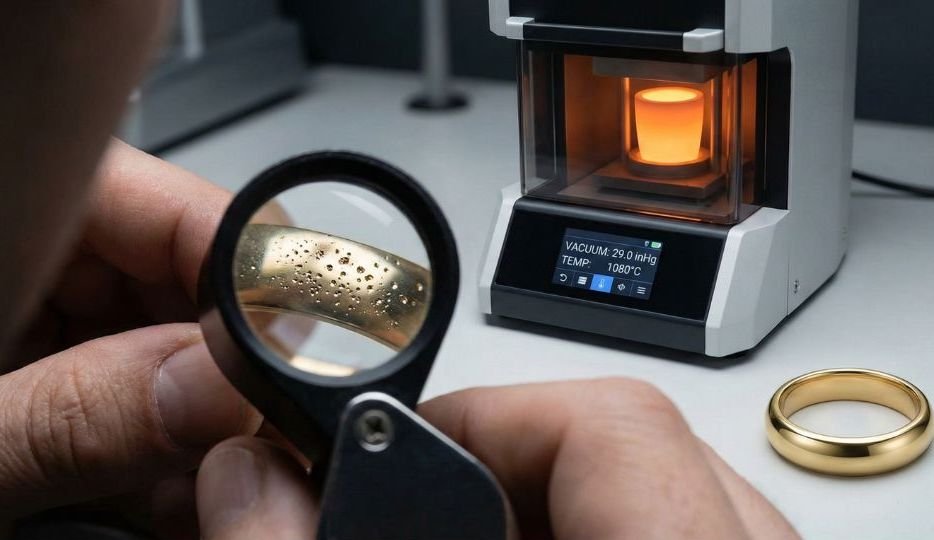
Gas Porosity: Round, spherical voids caused by dissolved gases (hydrogen, oxygen, nitrogen) coming out of solution as the metal cools. These typically appear as smooth-walled bubbles distributed throughout the casting.
Shrinkage Porosity: Irregular, interconnected voids that form when molten metal contracts during solidification without adequate feeding. These often appear in thicker sections or at junctions where metal flows meet.
Micro vs Macro Porosity: Microporosity consists of tiny pinholes invisible to the naked eye but revealed during polishing or under magnification. Macroporosity shows as visible surface defects or large internal voids detected through X-ray or ultrasonic testing.
Most casting defects involve a combination of these types, which is why a comprehensive approach to prevention is essential. Now let’s examine the root causes.
1. Poor Temperature Control During Melting
Temperature inconsistency is perhaps the most overlooked culprit behind porous castings. When gold is heated unevenly or brought to incorrect temperatures, several problems occur simultaneously.
The Problem: If your metal doesn’t reach the proper superheat temperature (typically 50-100°C above its melting point), it remains too viscous to flow properly into the mould. This thick, sluggish metal traps gas bubbles that would otherwise escape. Conversely, overheating causes excessive turbulence and can actually dissolve more gases into the molten metal.
The Fix: Invest in precise temperature monitoring equipment. Use pyrometers or thermocouples to track your metal temperature in real-time. For 18K yellow gold, aim for a pouring temperature between 1050-1100°C. Document your optimal temperatures for each alloy you work with and maintain consistency across batches.
Most importantly, avoid rapid heating or the use of oxidizing flames, which introduce oxygen directly into your melt.
2. Contaminated or Moisture-Laden Investment
Your investment material is supposed to create a clean, gas-free mould cavity. When it contains moisture or contaminants, it becomes a porosity factory instead.
The Problem: Investment that hasn’t been properly dried releases steam when molten metal hits it. This steam has nowhere to go except into your casting, creating porosity. Similarly, old or improperly stored investment can absorb humidity from the air, compromising its integrity.
The Fix: Always follow your investment manufacturer’s recommended burnout schedule precisely. The burnout cycle isn’t just about removing wax—it’s about driving out every trace of moisture from the investment. Most quality investments require holding at 730-760°C for at least 1-2 hours.
Store your investment powder in airtight containers with desiccants, and never use investment that’s been opened for more than six months. When mixing investment, use the exact water-to-powder ratio specified—approximations lead to structural weaknesses.
3. Inadequate Vacuum Pressure: The Secret to Smooth Gold
Here’s where many casting operations lose the battle against porosity: they underestimate the critical importance of vacuum pressure throughout the entire casting process.
The Problem: Gas bubbles form in molten metal from dissolved gases (primarily hydrogen and oxygen) coming out of solution as the metal cools. Without sufficient vacuum pressure, these gases have no incentive to leave the metal. They simply solidify in place, creating the porosity you see after polishing.
The Secret: Vacuum pressure doesn’t just help during pouring—it needs to be maintained at optimal levels during melting, pouring, and the initial solidification phase. This creates a pressure differential that literally pulls gases out of the molten metal before they become trapped.
Professional casting operations maintain vacuum levels between 28-29 inches of mercury (or approximately 700-735 mmHg) during the critical casting window. This isn’t optional—it’s the difference between flawless castings and scrap metal.
The Imtex Advantage: The Imtex Vacuum Casting Machine addresses this challenge with advanced pressure sensors that monitor and maintain optimal vacuum levels throughout the entire casting cycle. Unlike conventional machines that rely on fixed settings, Imtex’s system automatically compensates for variables like flask size, metal volume, and ambient conditions. This intelligent pressure management eliminates gas bubbles instantly, ensuring consistently smooth, porosity-free castings even with challenging alloys.
4. Improper Metal Preparation and Grain Refiners
The quality of your metal before it enters the crucible significantly impacts your final casting quality.
The Problem: Recycled metal often contains dissolved gases from previous melts. Without proper degassing or grain refinement, each subsequent melt accumulates more contamination. Old metal also tends to have oxide layers that introduce oxygen into your melt.
The Fix: Always use clean, properly refined metal. When working with recycled material, use grain refiners specifically designed for your alloy. For gold alloys, additions of small amounts of boron, silicon, or proprietary grain refiners help create a finer grain structure that’s less susceptible to porosity.
Flux your metal properly during melting to capture oxides and prevent their incorporation into the casting. For gold alloys, a borax-based flux works well for most applications.
5. Rushing the Solidification Process
Patience during solidification separates excellent castings from mediocre ones. Many manufacturers make the mistake of quenching too early or disturbing the flask before complete solidification.
The Problem: Molten metal continues to release gases even after pouring. If you break vacuum too early or quench the flask while the casting is still in a semi-solid state, you trap these late-stage gases as porosity. This is especially problematic with larger or thicker pieces that solidify slowly from the outside in.
The Fix: Allow adequate solidification time under vacuum before breaking the seal. For small castings, this might be 3-5 minutes; for larger pieces, wait 8-10 minutes or longer. The metal should be below its solidus temperature (the temperature at which it’s completely solid) before you disturb the flask.
When in doubt, wait longer. The few extra minutes of patience cost nothing but prevent costly defects.
Your Porosity Prevention Checklist
Use this checklist before every casting session to ensure optimal results:
✓ Temperature Control
- Correct superheat temperature achieved and logged
- Pyrometer calibrated and functioning
- Heating rate controlled (no rapid temperature spikes)
✓ Investment Preparation
- Investment stored airtight with desiccant
- Proper water-to-powder ratio measured precisely
- Complete burnout cycle followed (including hold time at peak temperature)
✓ Vacuum System
- Vacuum level maintained at 28-29″ Hg during melt, pour, and solidification
- Pressure sensors checked and calibrated
- No leaks in vacuum chamber or seals
✓ Metal Quality
- Clean metal or properly refined recycled material used
- Grain refiner added to melt
- Appropriate flux applied to capture oxides
✓ Solidification Protocol
- Adequate cooling time under vacuum maintained
- Flask not disturbed until metal reaches solidus temperature
- Quenching delayed until complete solidification verified
Print this checklist and post it at your casting station. Consistent adherence to these fundamentals eliminates 95% of porosity issues.
Bringing It All Together: A Systematic Approach
Eliminating porosity isn’t about fixing one variable—it’s about controlling the entire casting environment. Temperature control, investment preparation, vacuum pressure management, metal quality, and timing all work together to produce flawless castings.
The manufacturers who consistently produce porosity-free castings share one trait: they treat casting as a precision process, not a craft tradition. They measure, document, and refine their parameters until every variable is optimized.
Modern vacuum casting technology, particularly systems with intelligent pressure monitoring like those from Imtex, remove much of the guesswork from this equation. When your equipment actively prevents porosity rather than simply hoping for the best, your reject rate drops, your reputation grows, and your profitability soars.
The Business Case: Why Fixing Porosity Matters to Your Bottom Line
Let’s talk numbers. Reducing porosity by even 2-3% can save lakhs annually in gold wastage alone. Consider this:
If your operation casts 10kg of gold monthly with a 5% rejection rate due to porosity, that’s 500g of rejected metal per month—6kg annually. At current gold prices, that represents a direct loss of several lakhs in material costs, not counting the labour, investment materials, and opportunity cost of production time.
Beyond material savings, porosity-free castings mean:
- Faster production cycles (no rework or remelting)
- Improved customer satisfaction (fewer returns and complaints)
- Enhanced reputation (word spreads about consistent quality)
- Better margins (premium pricing for guaranteed quality)
Most manufacturers who upgrade to precision vacuum casting systems report ROI within 6-12 months purely from reduction in metal wastage and rework. The quality reputation benefits compound over years.
Your Next Step
If you’re still battling porosity despite your best efforts, it’s time to evaluate whether your equipment is holding you back. The best technique in the world can’t overcome inadequate vacuum systems or imprecise temperature control.
Audit your current process against the checklist above. Document your vacuum levels, measure your temperatures, and examine your investment procedures. Often, the fix is simpler than you think—but you can’t improve what you don’t measure.
Calculate your current rejection rate and metal wastage cost. If the numbers are significant, investing in advanced casting technology isn’t an expense—it’s a profit-generating decision with measurable ROI.
Porosity doesn’t have to be your enemy. With the right knowledge, equipment, and attention to detail, you can produce consistently beautiful, structurally sound castings that build your reputation as a quality manufacturer.
After all, when your customers trust that your castings will be flawless every time, you’ve solved the problem that matters most—and they’ll trust you forever.
Frequently Asked Questions
Q: Can porosity be completely eliminated from gold castings?
A: While achieving absolute zero porosity is theoretically challenging, modern vacuum casting systems combined with proper technique can reduce porosity to levels that are invisible even under 10x magnification. For commercial jewellery production, this effectively means porosity-free castings.
Q: How do I know if my vacuum pump is providing adequate pressure?
A: Install a calibrated vacuum gauge that measures in inches of mercury (Hg). During casting, you should consistently achieve 28-29″ Hg. If your vacuum can’t reach these levels, your pump may need maintenance, oil replacement, or replacement entirely. Annual calibration of gauges is recommended.
Q: Is porosity worse with recycled gold compared to virgin metal?
A: Recycled gold can contain more dissolved gases and oxides from previous melts, making it more prone to porosity if not properly processed. However, with correct refining, grain refiners, and vacuum casting technique, recycled gold can produce results identical to virgin metal. The key is proper preparation, not avoiding recycled material.
Ready to eliminate porosity from your casting operation? Discover how Imtex Vacuum Casting Machines help jewellery manufacturers achieve consistent, porosity-free results while reducing metal wastage and improving profitability.